Are Trading Bots Profitable in 2026
Trading bots can be profitable, but most retail bots are not. Here is what the research shows, why they fail, and how to check one before you trust it.

The short answer
Trading bots can be profitable, but for most retail users they aren't. A bot is only ever as good as the strategy inside it, and automating a weak strategy just loses money faster and more consistently. The edge comes from the rules, the risk management and the costs, not from the automation itself.
The rest of this article covers what the research shows, why most bots fail, how the main platforms differ, whether any of this is legal, and how to check a bot before you trust it with real money.
What the evidence says about trading bot profitability
There's no clean, industry-wide dataset on retail bot performance, largely because the people selling bots have no incentive to publish one. What we do have is a set of adjacent findings, and they point the same way.
Start with the fact that retail trading is difficult before you automate anything. Chague, De-Losso and Giovannetti tracked every individual who began day trading Brazilian index futures between 2013 and 2015. Of those who persisted for more than 300 days, 97% lost money, and only 1.1% earned more than the Brazilian minimum wage. The researchers found no evidence of learning either. The traders who kept going simply kept losing. Regulated brokers tell a similar story with their own numbers: ESMA found that between 74% and 89% of retail CFD accounts lose money, which is why UK and EU brokers have to display that percentage on their own marketing.
Automation doesn't fix that, and it introduces a problem of its own: the gap between the backtest and reality. Industry estimates commonly put live performance 30% to 50% below backtested performance once fees, slippage and real fills are accounted for, and heavily optimised strategies fare worse still. A significant share of documented strategies simply fail to reproduce their results on fresh data.
Regulators have been unusually direct about how all this gets marketed. The CFTC published a customer advisory titled "AI Won't Turn Trading Bots into Money Machines", warning that AI can't predict the future or sudden market changes, and that claims of high or guaranteed returns are a red flag for fraud.
You'll also see far rosier figures quoted, usually something like "60% of algorithmic traders are profitable". Treat those carefully. They almost always come from vendors, they rarely define the time period or the capital base, and they carry a brutal survivorship bias: people who lose money quietly switch the bot off, while people who make money post screenshots and sell courses.
Why most trading bots lose money
The failure modes are well understood and they repeat. The biggest is overfitting. Tune enough parameters against enough history and you'll always find a strategy that would have printed money, but that's a description of the past rather than an edge. A backtest showing an 80%+ win rate is usually evidence of curve fitting, not skill.
Close behind are the costs the backtest quietly ignored. Commission, spread, slippage, financing and tax turn a marginal edge into a loss, and the more often a bot trades, the more often you pay them. Then there's regime change: a strategy built on a trending market can fall apart in a choppy one, and a fixed rule set has no way of noticing that the market has changed character.
Leverage makes all of this sharper. It doesn't improve a strategy, it just scales whatever the strategy already does, losses included. And the "set it and forget it" pitch sits awkwardly with the reality that a bot running on a broken assumption can do a lot of damage before anyone checks on it.
Finally, be honest about the incentives. A vendor selling a subscription earns the same whether your bot wins or loses. If a strategy genuinely produced reliable outsized returns, selling access to it for $49 a month would be a strange business decision.
How the main automated platforms compare
"Trading bot" covers several quite different products, and the important difference between them is how much of the decision they take away from you.
| Platform | What it automates | Who places the trade | Typical cost |
|---|---|---|---|
| Composer | No-code rules-based portfolios, backtested and executed in one account | The platform | ~$32/mo |
| Trade Ideas (Holly AI) | AI-generated daily trade signals from overnight simulations | You, or the platform on higher tiers | ~$127 to $254/mo |
| TrendSpider | Technical analysis: trendline detection, pattern scanning, visual strategy building | You | ~$59 to $99/mo |
| 3Commas / Pionex | Crypto grid, DCA and arbitrage bots across exchanges | The bot | Free to ~$50/mo, plus trading fees |
| MetaTrader 5 (Expert Advisors) | Fully custom coded strategies with broker execution | The EA | Free platform, paid EAs vary |
| Bounce Trade | Screening, rule testing, and tracking your strategy's picks through to exit | You, every time | 14-day free trial, then $29.99/mo |
Read down the third column and the trade-off is clear. The more of the process a platform takes over, the less you can see of why it did what it did. That matters more than it sounds, because when an automated strategy stops working you have to decide whether it hit an ordinary losing run or genuinely broke, and you can't make that call on logic you never saw. It's also why crypto grid bots and paid Expert Advisors attract the most complaints: the execution is effortless, the reasoning is invisible, and the first clear signal that something is wrong is usually the account balance.
Where automation genuinely helps
None of this makes automation worthless. It just solves a narrower problem than it's sold as solving, and its real strength is consistency. Most retail losses come from breaking your own rules: moving a stop, sizing up after a loss, or sitting out the one trade that would have worked. Software doesn't have moods. It's also far better than you at coverage, since watching 200 tickers for a specific condition is trivial for a machine and impossible for a person.
The most underrated benefit is that writing rules down makes them testable at all. Backtesting is much better at eliminating bad ideas than confirming good ones, which is still enormously useful when the alternative is finding out with real money. The same goes for position sizing, where automating the calculation takes the most damaging discretionary decision away from you at the worst possible moment.
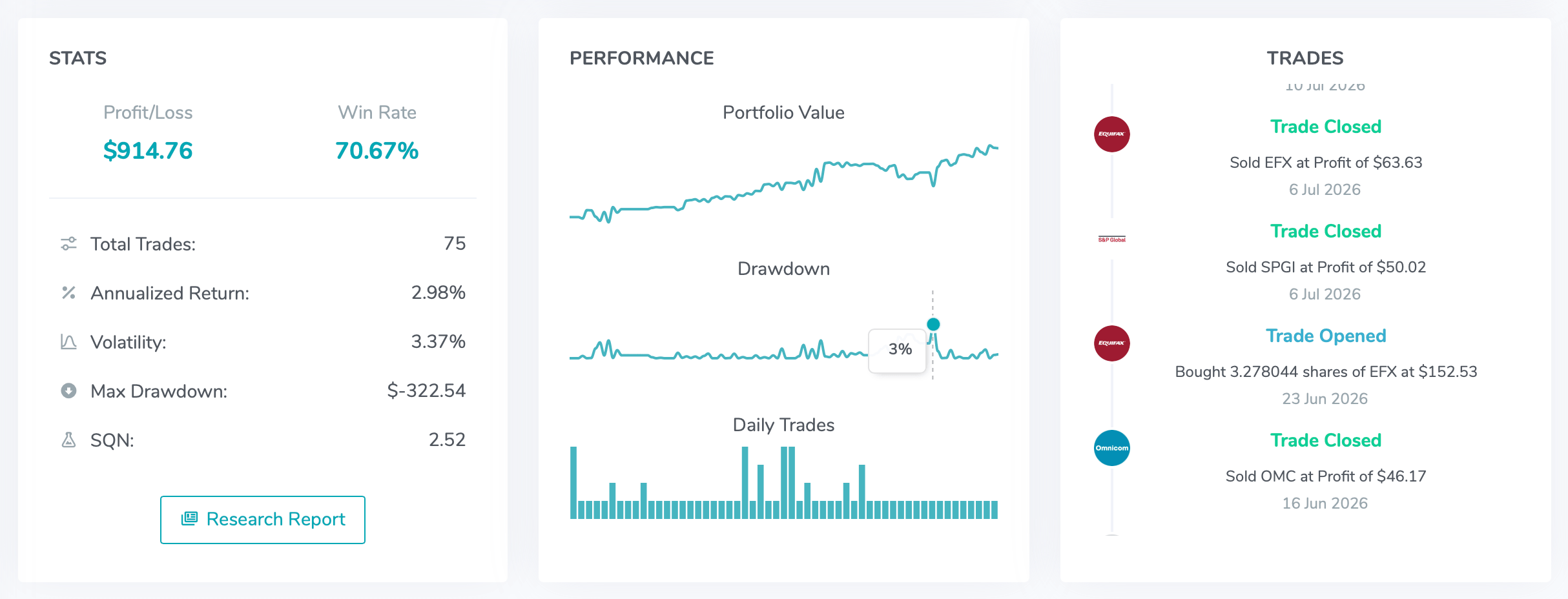
What you want out of a test isn't a headline return. It's the shape of the thing: the drawdown, the losing streaks, the trade-by-trade record of when the rules worked and when they didn't.
Institutions do run profitable automated strategies, which gets used as proof that retail bots work too. It isn't. They operate with co-located infrastructure, direct market access, cheap capital and cost structures a retail account can't touch, so their edge lives precisely where retail can't compete.
Are trading bots legal?
In short, yes. Using automated trading software as a retail investor is legal in the UK, the US, the EU and most other major jurisdictions, provided you're trading your own money through a regulated broker. There's no rule against telling software to place your orders.
The detail matters more than the headline. Your broker's terms come first, and while most permit automated trading, some restrict order frequency or particular tactics, so read the agreement before connecting anything to an API. Market abuse is illegal however it's carried out, so spoofing, layering, wash trading and marking the close are prohibited whether a human or an algorithm places the orders, and not knowing what your bot was doing is not a defence.
Trading other people's money is a different activity altogether. Running a bot on your own account is one thing, but pooling other people's funds or managing their accounts generally requires authorisation from the relevant regulator, and that's where a lot of bot operations cross a line. The fraud risk here is real and large: the CFTC has brought multiple cases against operators marketing AI trading bots with promised returns, including one where a defendant was ordered to pay over $3.4 billion in a forex fraud built around a bot guaranteeing at least 10% monthly.
So legality is usually the wrong thing to worry about. The bot is legal. The person selling you one with a guaranteed return is the problem.
How to evaluate a trading bot before you trust it
If you're still considering one, these are the checks worth doing:
- Who holds the money? If funds go anywhere other than your own account at a regulated broker or exchange, stop there.
- Is any return "guaranteed"? Guaranteed or fixed monthly returns are a red flag, not a feature. Regulators name this specifically.
- Does the track record show drawdown? Returns quoted without maximum drawdown and the losing periods are marketing, not performance.
- Were fees and slippage in the backtest? If the vendor can't answer precisely, assume they weren't.
- Is there out-of-sample evidence? A strategy tested on the data it was built from tells you nothing.
- Can you see and change the rules, and switch it off instantly? If the logic is a black box, you'll never know when to stop it.
A different approach: rules without the black box
There's a middle ground between trading on instinct and handing your account to software you don't understand, and it's where most consistent retail traders actually operate. You write the rules down, you test them against real market history, you get told when they trigger, and you make the call.
That's what Bounce Trade is built for. The strategy builder lets you define entry and exit conditions without writing code, so the logic stays yours and stays visible. Backtesting runs those rules over historical data, so an idea that doesn't work costs you an afternoon instead of a quarter. Once a strategy is live it watches the market for you: when a stock meets your entry criteria it sends you the pick, and if you accept it, the position is tracked from there with live price history and an exit notification when your stop loss or exit condition is hit. If you want to put real money behind it, you copy the values across to your broker. The trading journal and position sizing calculator keep the review loop and the risk honest.
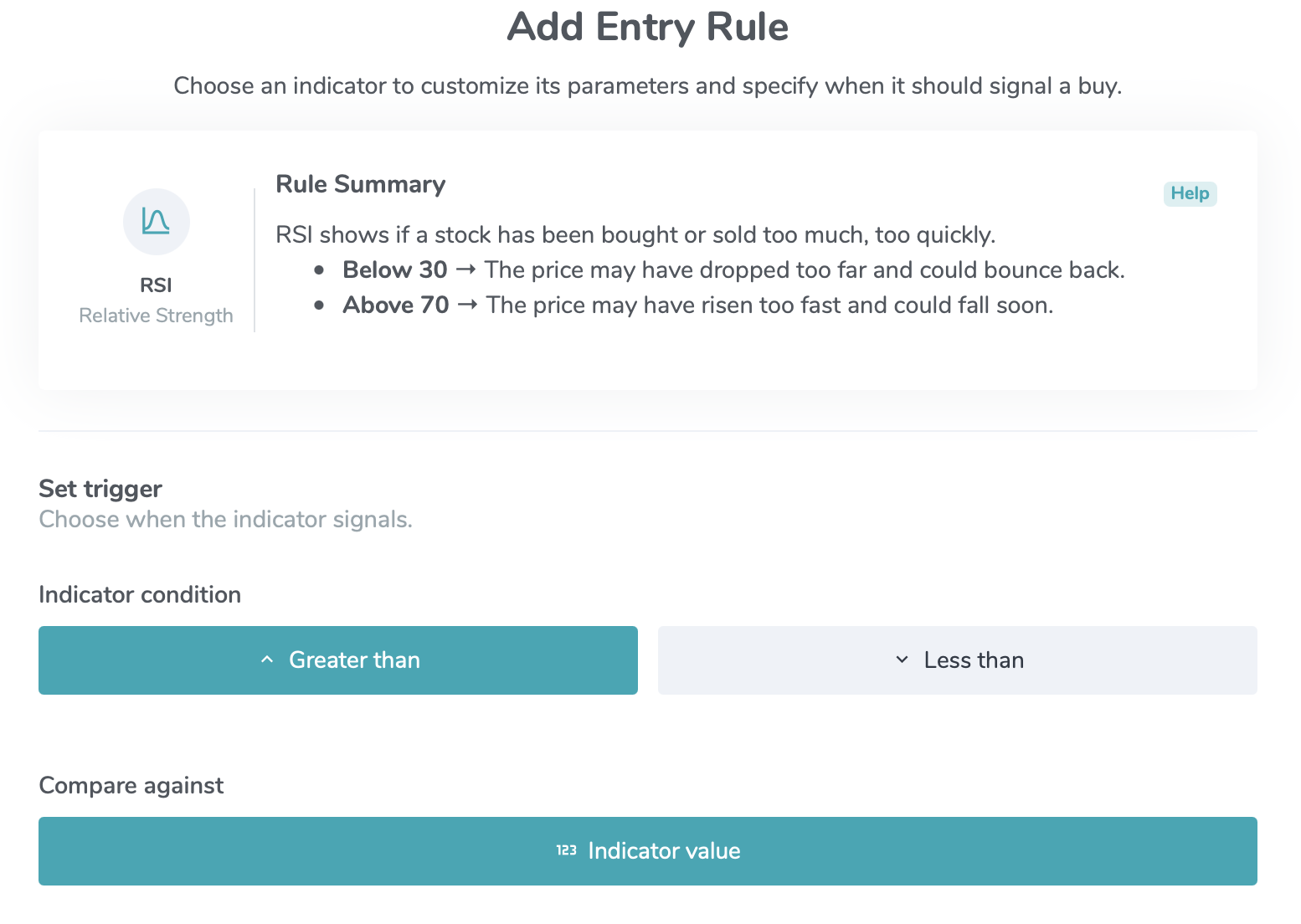
The distinction that matters is what's being automated. Bounce automates the watching and the record keeping, not the deciding or the executing. It doesn't place orders and it doesn't choose for you: every pick is yours to accept or ignore, and every order is yours to place. That also means every result is yours to own, and when a strategy stops working you can see exactly which rule stopped paying.
Frequently asked questions
Are trading bots profitable for beginners?
Rarely. A bot magnifies whatever strategy you give it, and beginners usually don't have a tested one yet.
Can a trading bot make you rich?
There's no evidence that retail trading bots reliably produce outsized returns, and regulators actively warn against anyone claiming otherwise. Anything promising guaranteed or fixed monthly returns should be treated as a fraud risk.
Are free trading bots worth using?
They're a reasonable way to learn how automation works, but not a shortcut to an edge, and "free" often means the cost sits somewhere less visible such as spreads or an upsell.
Why did my bot work in backtesting but lose money live?
Almost always overfitting, unmodelled costs, or a change in market conditions. Live results running below the backtest is the normal outcome, not the exception.
Is it better to trade manually or use a bot?
It depends which part of your process is failing. If you can't find or test ideas, automation helps. If you have ideas but keep breaking your own rules, structure and alerts help more than full automation, and you keep the ability to see why something stopped working.
Conclusion
Are trading bots profitable? Some are, for some people, some of the time. But profitability comes from a tested strategy, honest cost assumptions and disciplined risk management, and a bot supplies none of those. It just executes what you already have, faster.
So if you don't yet have rules you trust, automation is the wrong problem to solve first. Write the strategy down, test it against real history, and see whether it survives contact with costs and out-of-sample data. You can do that with the free tools, or read our comparison of the best stock analysis sites if you're still choosing where to research. The edge is in the process, not the automation.
Risk warning. Bounce Trade provides research, data and tools for informational and educational purposes only. Nothing in this article is investment advice or a recommendation to buy or sell any security, and we are not investment advisors or brokers. Trading carries risk and you may lose money. Past performance does not indicate future results. You are responsible for your own trading decisions. Third-party products, prices and studies referenced here are cited for information only, are accurate as of August 2026, and are not endorsements. See our legal terms for details.
Start trading with structure
Try Bounce free for 14 days. Build a strategy, backtest it, and track how you actually trade.
Start Free 14 Day Trial