Position Sizing Calculator: How Many Shares Should You Buy?
Work out your share count in seconds, then learn the one formula that keeps a single bad trade from deciding your account's future.
Position size calculator
Your account size, the risk you'll take and where your stop sits. Works for longs and shorts.
Shares to buy
Position value
$2,000.00
You risk
$100.00
% of account
20.0%
If the stop is hit you lose $100.00, 1.00% of the account.
Share counts round down to whole shares. For information only, not investment advice.
Why position sizing matters more than your next stock pick
Most retail traders lose money not because their ideas are bad, but because they have no structure around them, and sizing is the first piece of that structure. Two traders can take the exact same trades and end up with completely different accounts, purely because one risked a fixed 1% per trade and the other sized on gut feel.
Position sizing answers one question before you enter: if this trade hits my stop, how much do I lose? Fix that number in advance, typically 1-2% of the account, and no single trade, streak of losses or gapped-through stop decides your account's future.
The formula
The standard fixed-fractional sizing formula is:
shares = (account size × risk %) ÷ (entry price − stop-loss price)
The top half is the cash you're prepared to lose. The bottom half is how much one share loses if the stop is hit. Divide them and you get the largest position whose worst planned outcome is exactly your chosen risk. The share count scales down automatically when your stop is wide, and up when it's tight. Risk stays constant either way.
A worked example
Say you have a $10,000 account and risk 1% per trade, which is $100. You want to buy at $50.00 with a stop at $47.50, so you're risking $2.50 per share.
| Account size | $10,000 |
| Risk per trade (1%) | $100 |
| Entry price | $50.00 |
| Stop-loss price | $47.50 |
| Risk per share | $2.50 |
| Shares to buy ($100 ÷ $2.50) | 40 shares |
| Position value | $2,000 (20% of account) |
If the stop is hit you lose $100, exactly 1% of the account. If your target is $55.00, you stand to make $5.00 per share against $2.50 risked: a 2R trade, risking 1% to make 2%. String together trades like that and a modest win rate is enough to grow the account; skip the sizing step and one oversized loser can undo a month of good trades.
Quick reference: shares to buy at 1% risk
Risk per share is the distance between your entry and your stop. Find your account size, read across:
| Account size | Risk (1%) | $0.50/share stop | $1.00/share stop | $2.50/share stop | $5.00/share stop |
|---|---|---|---|---|---|
| $2,500 | $25 | 50 | 25 | 10 | 5 |
| $5,000 | $50 | 100 | 50 | 20 | 10 |
| $10,000 | $100 | 200 | 100 | 40 | 20 |
| $25,000 | $250 | 500 | 250 | 100 | 50 |
| $50,000 | $500 | 1,000 | 500 | 200 | 100 |
Sizing is one rule. A strategy is the whole set.
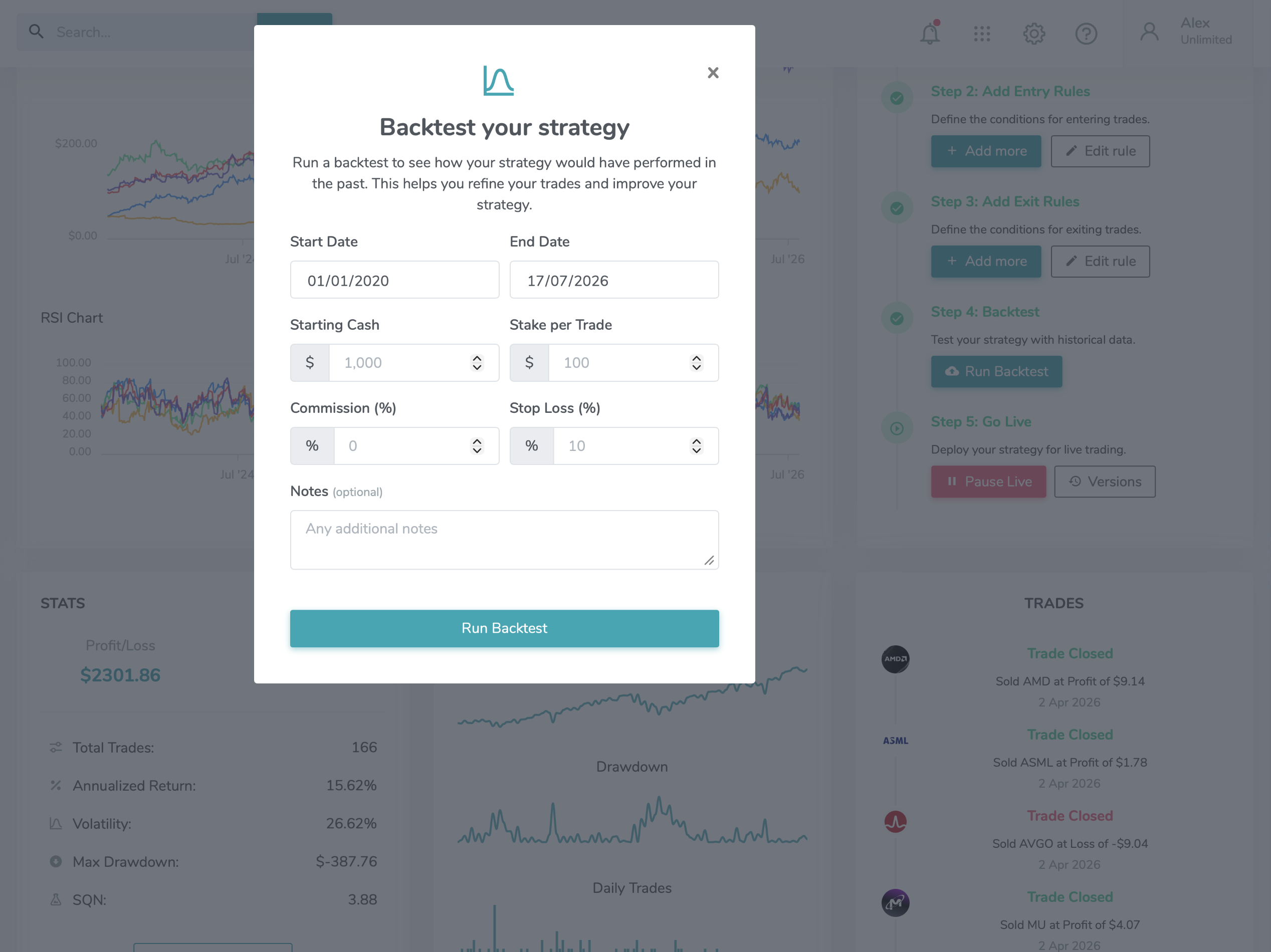
Position sizing tells you how much. It says nothing about what to buy, when to enter or when to get out, and a sizing rule you apply inconsistently is barely a rule at all. In Bounce, your stop distance and risk limits are part of the strategy itself, so every alert your rules generate already comes with its risk defined. See how strategies come together in the free backtesting tool, then track whether you actually follow them with a trading journal.
Frequently asked questions
How much should I risk per trade?
Most risk-management frameworks for retail traders suggest 1-2% of your account per trade. At 1% risk you can lose ten trades in a row and still have over 90% of your account; at 10% risk the same streak would cut your account roughly in half.
How do I calculate how many shares to buy?
Shares = (account size × risk %) ÷ (entry price − stop-loss price). The numerator is the cash you're willing to lose; the denominator is the loss per share if the stop is hit. The calculator at the top of this page does it for you, longs and shorts both.
What is an R-multiple?
R is the amount you risk on a trade. A trade that makes twice what you risked is +2R; a stopped-out trade is -1R. Measuring in R makes different-sized trades comparable and shows whether your winners outweigh your losers.
Does this work for short positions?
Yes. For a short, the stop sits above the entry. The formula uses the distance between entry and stop in either direction, so the share count is correct for longs and shorts.
For information only, not investment advice. Check the numbers against your broker before trading.
Put your risk rules inside a strategy
Bounce turns your entry, exit and risk rules into a strategy you can backtest on 5,000+ US stocks, then tells you when your setup appears.
Start Free 14 Day Trial