How to Build a Trading Strategy
Turn the ideas you already have into rules you can backtest, get alerts on and actually follow. No code required.
Ideas are cheap. Rules are what make money.
Every trader has ideas: buy the dip, ride the trend, fade the spike. The difference between traders who compound and traders who churn isn't better ideas; it's that the first group turned their ideas into rules: written conditions for entering, exiting and sizing that get followed the same way every time, then tested against history before risking a pound of real money.
That's all a trading strategy is: one idea, made precise enough to test and repeat. Here's the process, step by step.
The five steps
1. Start from one idea
Pick a single, specific idea you already believe in and write it as one sentence: "Quality stocks bounce back after they get oversold." If you can't state it in a sentence, it's not one idea yet. It's several, and each deserves its own strategy.
2. Define the entry rules
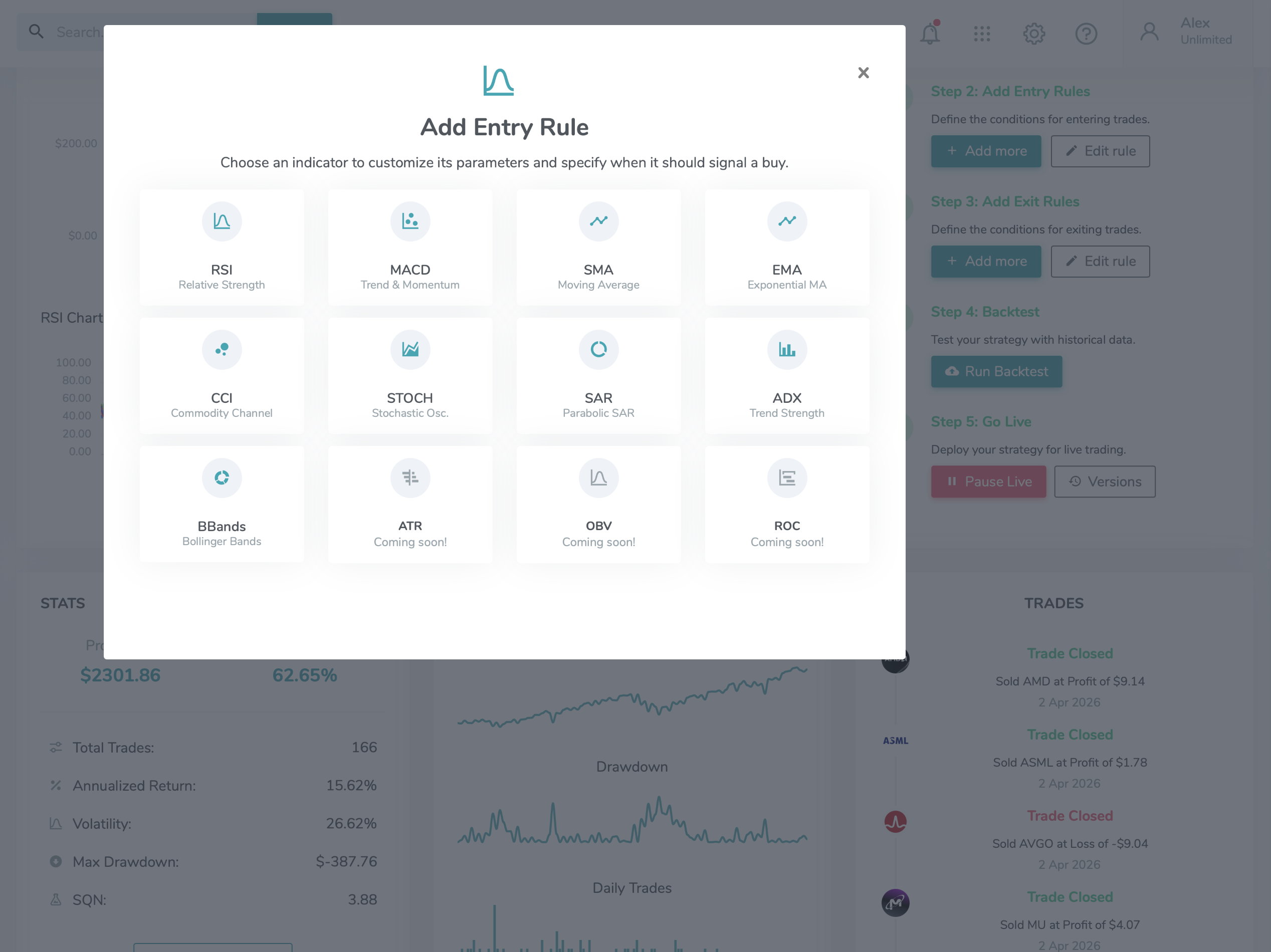
Translate the sentence into objective conditions. "Oversold" becomes RSI below 30. "Quality stocks" becomes price above the 200-day moving average. The test of a good rule: two strangers reading it would take exactly the same trade. Anything with "looks like", "feels", or "strong" in it isn't a rule yet.
3. Define the exit and the risk before you ever enter
Every strategy needs three more decisions made in advance: when to take profit, when to accept the loss (the stop), and how much of the account one trade may risk. See the position sizing guide for that last one. Exits decided mid-trade are decided by emotion; exits decided in advance are decided by the strategy.
4. Backtest it
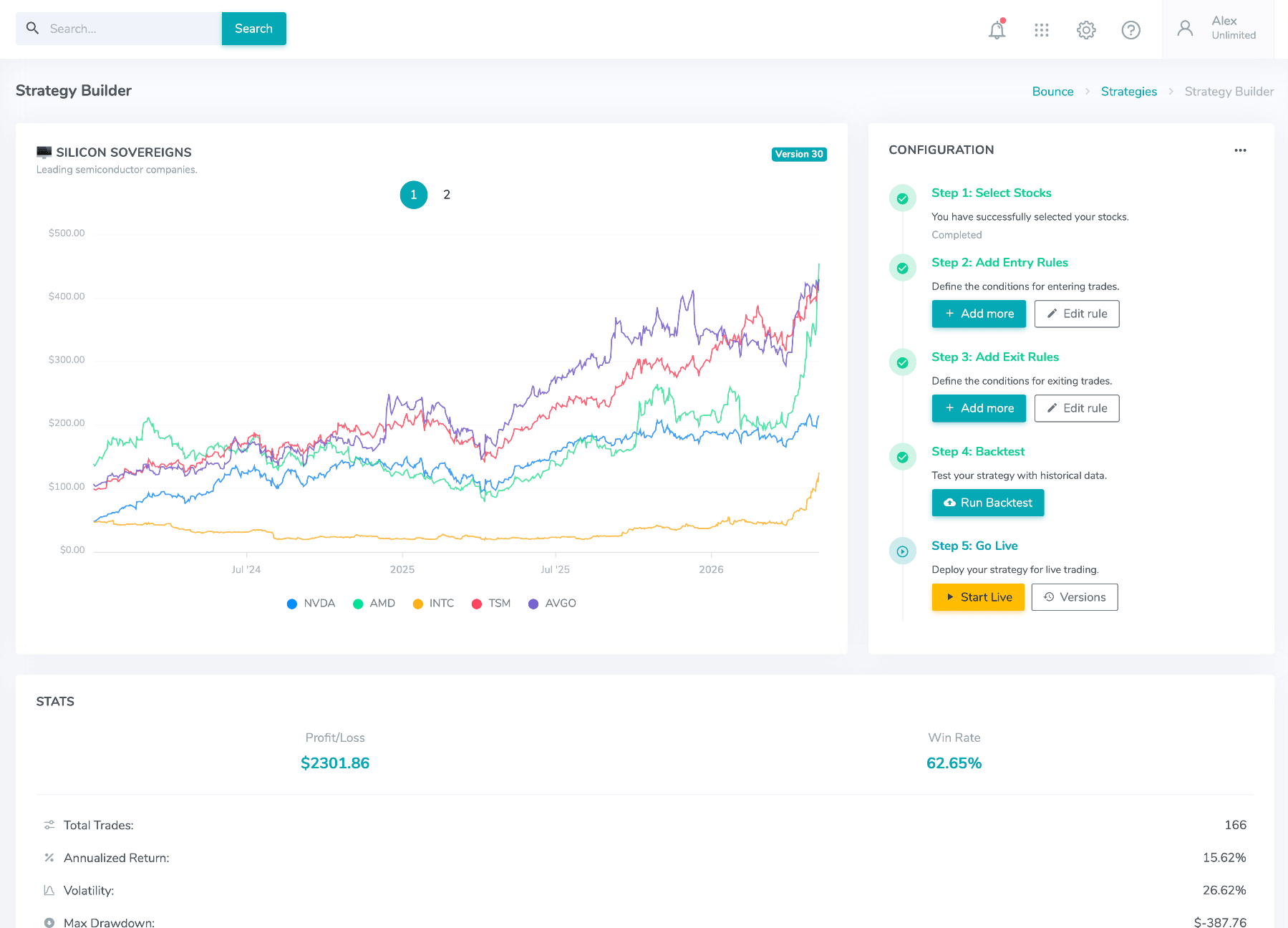
Run the rules over historical data and look at the four numbers together: win rate, total return, max drawdown and trade count. The backtesting guide covers how to read them, and how not to fool yourself. Most ideas fail here. That's the point: each failure costs you minutes instead of money.
5. Set alerts and follow it
A strategy you don't follow is a diary entry. The last step is operational: get alerted when your entry conditions appear (Bounce sends email, SMS, WhatsApp or Telegram), take only the trades that match the rules, and review monthly whether you actually did. Consistency, not brilliance, is what the first four steps were for.
Try it: click a strategy together
These are real conditions from the Bounce builder. Toggle a few and watch the idea become a precise, testable strategy. This is the entire skill:
Entry conditions
Exit & risk rules
Your strategy, in plain English
Select an entry condition and an exit rule to see your strategy take shape.
In Bounce these same conditions are clicked together on a canvas, then backtested across 5,000+ US stocks in one run.
The mistakes that kill first strategies
- Too many rules. Every condition you add fits the past a little better and predicts the future a little worse. One or two entry conditions is a strategy; seven is a curve-fit.
- No risk rule. A strategy without a stop and a size limit isn't incomplete, it's dangerous, because its worst case is unbounded. Decide both before the first trade.
- Testing until it looks good. If you tweak parameters until the backtest shines, the backtest is now describing your tweaking, not the market. Change rules for a reason, re-test once.
- Abandoning it after three losses. A 60% win-rate strategy loses three in a row regularly. If you'll abandon rules the first week they hurt, the problem is sizing (risk less), not the rules.
Frequently asked questions
Do I need to know how to code?
No. Rule-based strategies are combinations of objective conditions (indicator levels, price versus moving averages, volume thresholds) and a no-code builder lets you click them together and backtest without writing anything.
What makes it a strategy rather than an idea?
Rules precise enough that two people following them would take the same trades: an objective entry, an objective exit, and a risk limit. If any step still needs in-the-moment judgement, it's still an idea.
How do I know if my strategy is any good?
Backtest it. See the free backtesting tool. A good backtest isn't a guarantee, but a bad one kills a broken idea for the price of a few minutes.
How many rules should a strategy have?
Fewer than you think: one or two entry conditions, one or two exits, one risk limit. Add more only when a re-test shows the extra rule genuinely earns its place.
Build yours in the real thing
The same five steps, on a canvas: click your rules together, backtest them across 5,000+ US stocks and get alerts when your setup appears.
Start Free 14 Day Trial