Paper Trading Explained
Paper trading lets you practise with virtual money at real market prices. Here is what it teaches, what it cannot, the best simulators, and how to use it well.

What is paper trading?
Paper trading is placing trades with virtual money at real market prices, so you can practise a strategy without risking capital. The name comes from the days when traders tracked hypothetical positions on paper. Today it's done through a simulator that gives you a fake balance, live prices and the same order types you'd use with a real broker.
The appeal is obvious. You get to find out whether your idea works before it can cost you anything. The catch, which most guides skip, is that paper trading teaches some things extremely well and other things not at all, and knowing the difference is what separates useful practice from a false sense of confidence.
How paper trading works
You open a simulated account, usually funded with a round virtual number like $100,000, and place orders exactly as you would live. The simulator prices those orders against real market data, tracks your open positions and profit or loss, and keeps a history you can review.
Most simulators run on live market hours, so a stock trade placed at 2pm fills at the price the stock is actually trading at, and a position left open overnight is exposed to whatever the market does before the open. That's the part that makes it worthwhile: the price action is real even though the money isn't.
What paper trading is genuinely good for
The strongest case for paper trading is mechanical. Learning where the buttons are, what a stop limit order actually does, how options chains are laid out, and what happens when you fat-finger a quantity are all things you want to discover on a simulator rather than with real money. Platform errors are a genuine and underrated source of losses, and they're completely free to eliminate.
It's also good for testing whether you can follow a process at all. Can you wait for your setup instead of taking something close to it? Do you actually place the stop when you open the position? Do you record the trade? If the answer is no in a simulator, it will definitely be no with money on the line, and you've learned something valuable for free.
The third use is forward testing. A strategy tested only on the data you designed it around tells you very little, so running it on live prices you haven't seen before is a real check. Two months of forward testing usually tells you more about robustness than another year of tuning a backtest.
What paper trading can't teach you
Here's the part worth being blunt about, because it's why so many people paper trade brilliantly and then struggle live.
The first gap is emotional and it's large. A simulated account down 10% is mildly annoying. Your own savings down 10% triggers loss aversion, anchoring to your entry price, and the urge to make it back quickly. The rules don't change when you switch to real money, but your willingness to follow them does, and that's the variable a simulator can't measure. Traders who never broke a rule on paper move stops, chase entries and close winners early within a fortnight of going live.
The second gap is mechanical. Most simulators fill your limit and stop orders at exactly the price you asked for whenever the market touches it. Real markets skip past limits during fast moves and slip through stops in ways that cost real money. Commissions and spreads are often set to zero by default, so a strategy that trades frequently can look profitable on paper and be underwater live purely on costs. If your simulator lets you enter your broker's actual commission, do it on day one.
The third gap is liquidity. Simulators generally assume your order gets filled without affecting the market. That assumption holds fine for a hundred shares of a large-cap and falls apart on thinly traded small-caps or wide options spreads, which is exactly where inexperienced traders tend to go looking for big moves.
Best paper trading simulators in 2026
Most simulators are free, so the question isn't cost but whether it matches how you intend to trade for real. Practising on a platform you'll never use adds a layer you'll have to unlearn.
| Simulator | Markets | Virtual balance | Best for |
|---|---|---|---|
| TradingView | Stocks, ETFs, forex, crypto, futures, indices | $100,000, resettable | Practising directly on the chart you analyse |
| Webull | US stocks, ETFs, options, futures | $1,000,000, resettable | Beginners and mobile-first traders |
| thinkorswim paperMoney | US stocks, options, futures | $100,000 | Options traders wanting close-to-live conditions |
| Interactive Brokers demo | Global stocks, options, futures, FX, bonds | $1,000,000 | Broad market coverage once you know your way around |
| Bounce Trade | US stocks | No virtual cash, tracks your strategy's picks | Testing a written strategy rather than your screen time |
TradingView paper trading
TradingView's simulator is built into the chart, which is its main advantage. You analyse and place the order in the same window, using market, limit and stop orders against live data, and you can reset the account to whatever balance and leverage you actually intend to trade with. That last setting matters more than people realise: practising with $100,000 when you plan to fund $5,000 teaches you position sizing that won't transfer.
Two limitations to know about. There's no realistic slippage modelling, so stops and limits fill exactly where you place them, and commission is zero unless you enter your broker's rates yourself. It's free on every tier, including the basic plan.
Webull paper trading
Webull's simulator mirrors its live app closely, which is the main reason to choose it: what you learn is what you'll use. It covers US stocks, ETFs, options and futures with live pricing, real bid-ask spreads and normal market hours including extended sessions, and you can reset the virtual cash as often as you like.
Two things to watch. The default virtual balance is $1,000,000, which is unhelpful unless you change it, because a 2% position at that size bears no relationship to how you'll actually trade. And the paper trading leaderboard rewards whoever posted the biggest percentage gain, which quietly encourages exactly the concentrated, oversized risk-taking you're supposed to be training yourself out of. Ignore it.
How to paper trade so it's actually worth doing
Most paper trading is wasted, not because the tool is bad but because it's used without any of the constraints that make real trading hard. A few rules fix that.
Set the account up to match reality before you place a single trade:
- Fund it with what you'll actually trade. If you plan to start with £5,000, set the simulator to £5,000.
- Enter your broker's real commissions and expected spread. Zero-cost trading is the single most misleading default.
- Write the strategy down first. Entry condition, exit condition, stop, and position size. If you can't write it, you're not testing it, you're just clicking.
- Fix the review period in advance. Something like 40 trades or eight weeks, decided before you start so a bad run can't tempt you into changing the rules mid-test.
- Log every trade, including the ones you skipped. The trades you talked yourself out of are usually the most revealing.
- Never reset the balance to hide a drawdown. The drawdown is the data.
Then treat the result as a filter rather than a forecast. A strategy that loses on paper will almost certainly lose live. A strategy that wins on paper has cleared the lowest bar, nothing more, because it hasn't yet been tested against costs you underestimated or emotions you haven't felt.
When to switch to real money
There's no universal number of trades, but there are reasonable signals. You've followed your own rules consistently for a meaningful sample. You've had a losing streak and didn't change the strategy in the middle of it. Your logged results include realistic costs. And you can state, in a sentence, what your edge is and under what conditions it stops working.
When you do switch, go live with a position size small enough that the money is real but the loss is survivable, because the point of the first live phase is to find out how you behave, not to make money. Expect your results to get worse. That's normal, and the gap between your paper results and your first live results is itself useful information about how much of your performance was the strategy and how much was the absence of pressure.
Backtest first, then paper trade
Paper trading has one structural weakness as a testing method: it runs at the speed of the market. Gathering 40 trades on a swing strategy can take months, and at the end you've got a sample small enough that luck explains most of it.
That's why it works best as the second step rather than the first. Backtesting answers a different question much faster, which is whether the idea has ever worked across years of market history, including conditions you haven't personally traded through. Most ideas die at that stage, and killing them in an afternoon is far better than discovering it over a slow quarter on a simulator.
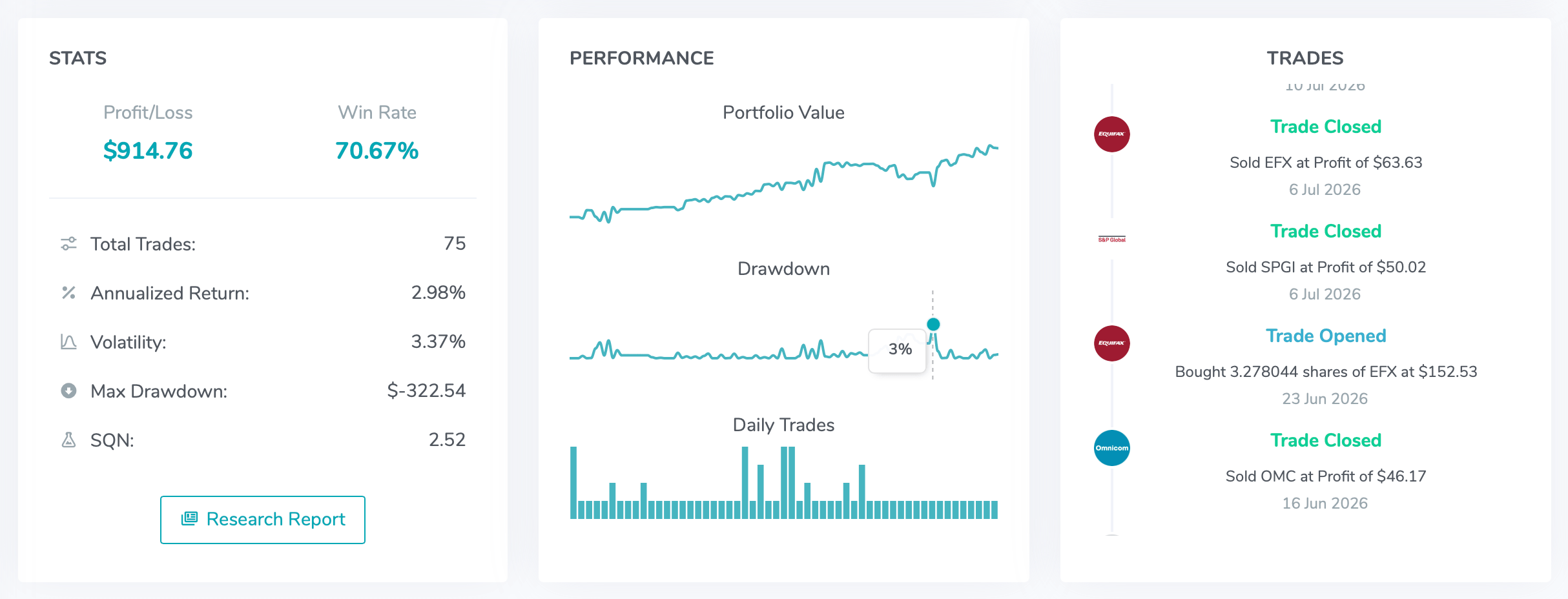
That's the sequence Bounce Trade is built around, and it runs both halves. You define the rules in the strategy builder without writing code, then backtest them across real historical data to see the drawdowns and losing streaks as well as the returns. Whatever survives, you activate.
From there it forward tests itself. When a stock meets your entry criteria the strategy sends you the pick, and if you accept it, Bounce tracks the position from that moment: live price history while it's open, and an exit notification when your stop loss or exit condition is hit. At the end you have a record of how the strategy actually performed on trades you hadn't seen when you wrote the rules.
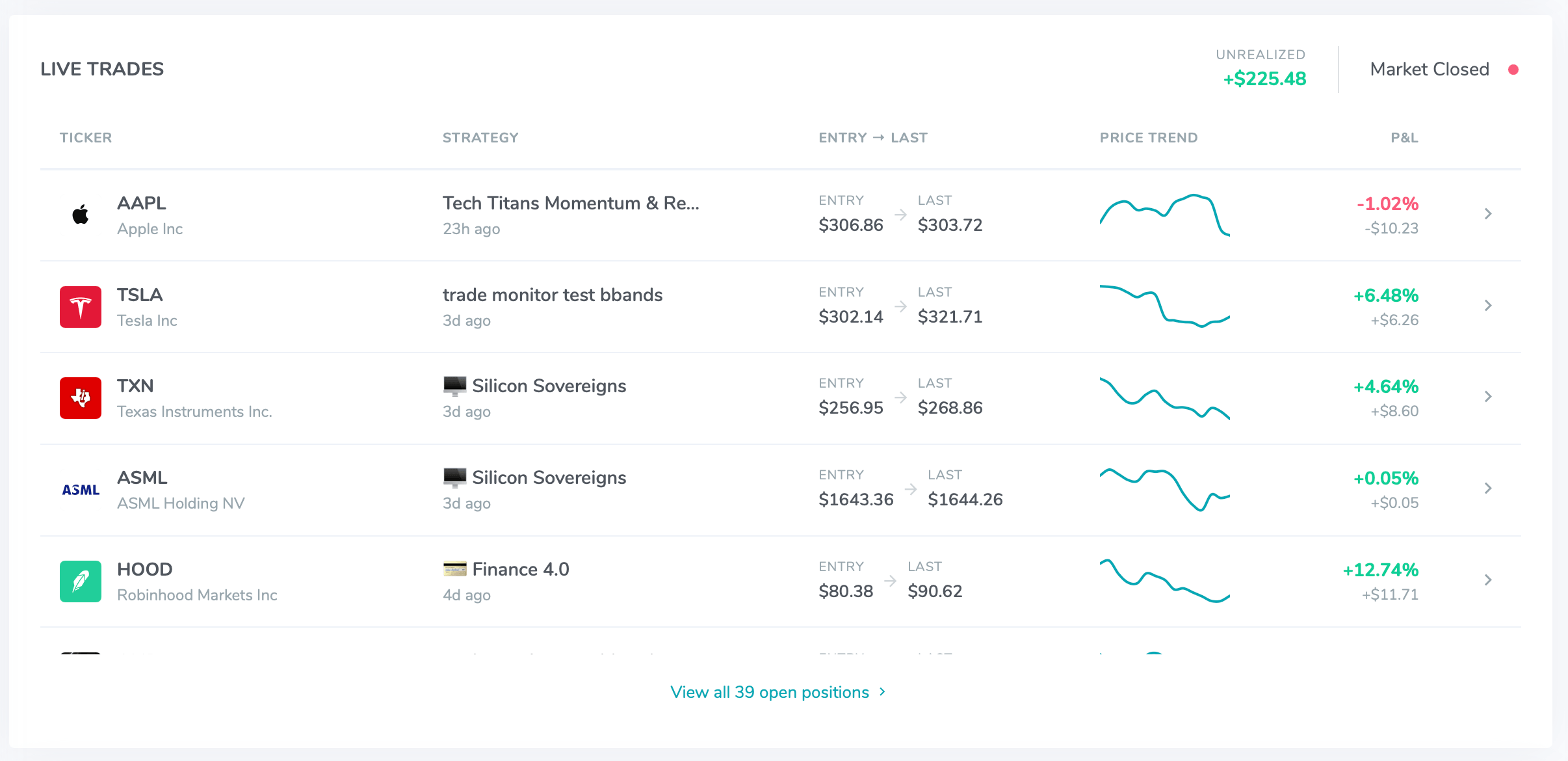
Two things follow from that. The first is that you're testing the strategy rather than your ability to watch a screen, which is the flaw in most manual paper trading. Miss the entry because you were in a meeting and you haven't tested the strategy, you've tested your availability. The second is that going live is a small step rather than a new system: when you're ready to put money behind a strategy, you copy the values across to your broker and carry on with the same rules, the same picks and the same record.
Worth being precise about what it isn't. Bounce doesn't place orders and doesn't model order fills, spreads or slippage, so the caveats earlier in this article still apply to the numbers. It tracks what your rules said to do and what happened next, which is the part that tells you whether the strategy is worth funding.
Frequently asked questions
Is paper trading free?
Almost always. TradingView, Webull, thinkorswim and Interactive Brokers all offer simulated accounts at no cost, though some require you to open or apply for an account first.
How long should you paper trade?
Long enough for a meaningful sample and at least one losing streak, which for most swing strategies means a couple of months rather than a couple of weeks. Decide the period before you start.
Is paper trading realistic?
The prices are. The fills, costs and psychology usually aren't. Enter your real commissions, set a realistic balance, and treat the emotional side as untested.
Can you make money paper trading?
No. The profits are simulated. Some prop firm evaluations use simulated accounts and pay out on real funded accounts afterwards, but that's a different arrangement with its own rules and fees.
Does paper trading work for beginners?
Yes, for learning mechanics and testing discipline, which is exactly what beginners need. It just shouldn't be read as evidence that you'll be profitable live.
Can I paper trade a strategy on Bounce Trade?
Effectively yes. Activate a strategy and it sends you a pick when a stock meets your entry criteria, tracks the position if you accept it, and notifies you when your stop loss or exit condition is hit. If you don't place the trade with a broker, that's paper trading. If you do, you copy the values across and the tracking carries on the same way.
Why do I lose money live after winning on paper?
Usually costs the simulator ignored, fills better than you'll get in reality, and the behavioural difference once real money is at stake. All three are predictable, and all three shrink if you paper trade with realistic settings and a written strategy.
Conclusion
Paper trading is a genuinely useful tool that gets oversold. It's excellent for learning a platform, pressure-testing whether you can follow a process, and forward testing an idea on prices you haven't seen. It can't price your emotions, it flatters your fills, and it will happily ignore the costs that decide whether a strategy is viable.
Use it as one step in a sequence rather than a verdict. Write the strategy down, backtest it to find out whether it has ever worked, forward test what survives with realistic settings, then go live small. You can run that whole sequence on Bounce: build the rules, backtest them, activate the strategy and let it send you picks to track, then copy the values to your broker when you're ready to fund it. Starting is free, and our guide to the best stock analysis sites covers where to do the research alongside it.
Risk warning. Bounce Trade provides research, data and tools for informational and educational purposes only. Nothing in this article is investment advice or a recommendation to buy or sell any security, and we are not investment advisors or brokers. Trading carries risk and you may lose money. Past performance, including simulated and backtested performance, does not indicate future results. You are responsible for your own trading decisions. Third-party platforms and their features are described for information only, are accurate as of August 2026, and are not endorsements. See our legal terms for details.
Start trading with structure
Try Bounce free for 14 days. Build a strategy, backtest it, and track how you actually trade.
Start Free 14 Day Trial